
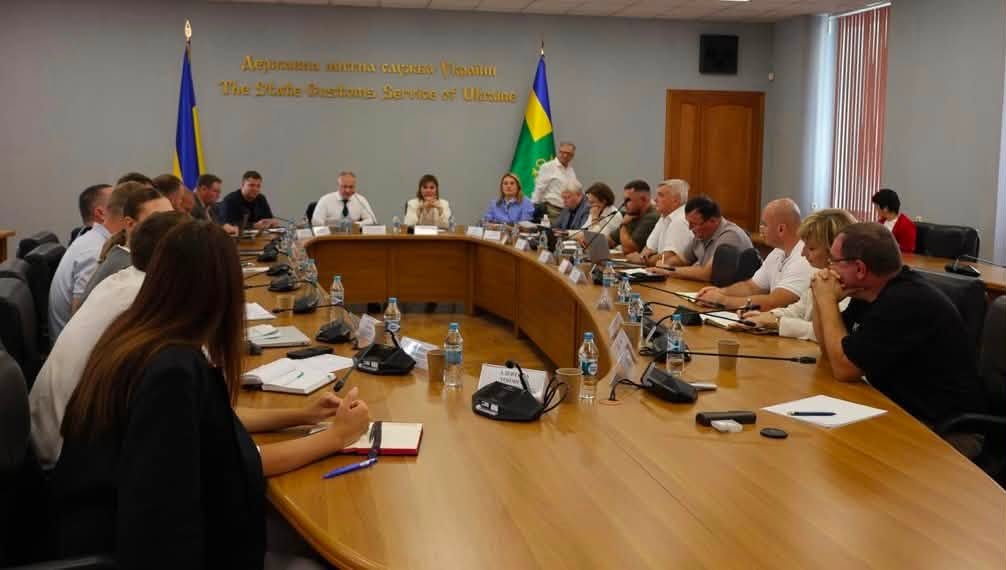
Last week, an extended meeting of the Public Council under the State Customs Service was held in a round-table format with the participation of representatives of the Cabinet of Ministers, the Ministry of Finance, the State Customs Service, large businesses and relevant business associations. The event was attended online by Halyna Polyakova, head of the customs clearance department at GRANDAR.
The discussion brought participants together around the main point: in wartime, customs procedures must respond to real security and economic challenges.
Head of the State Customs Service of Ukraine Orest Mandziy spoke about the scale of damage to customs infrastructure and problems affecting certain areas, in particular:
🔸at Odesa Customs (massive attacks on the “Tabaky”, “Vynohradivka” and “Orlivka” checkpoints; due to the shallowing of the Danube and shelling of the ports of Odesa region, practically only the ports of Izmail and Reni are operating; cargo flows through Odesa Customs have decreased by 80%);
🔹7 enterprises with AEO (Authorized Economic Operator) status were affected;
🔸raised the issue of closing open data on the locations of customs infrastructure.
🔹refuted information about the forced deployment of customs officers to Kyiv to undergo certification.
As Halyna Vdovina, Head of the Public Council under the State Customs Service, emphasized, currently every hour of cargo downtime, traffic congestion or people’s presence in dangerous areas is not only an economic loss, but also an additional risk to life.
“When cargo or a truck enters the customs control zone – it is already a target. These are our people, these are customs officers, these are drivers, this is the infrastructure itself. Therefore, it is necessary not only to eliminate the consequences of traffic congestion, but also to eliminate the root cause – to transfer customs formalities to a safe format as much as possible”, said Viktor Berestenko, President of the Association of International Freight Forwarders of Ukraine.
In response, Oleksandr Moskalenko, Director of the Customs Policy Department of the Ministry of Finance, reported on the preparation of amendments to relevant orders that will allow customs clearance to be optimized and, in certain cases, initiated even before the transport arrives.
Tetiana Ostrikova, an expert of the Public Council under the State Customs Service, proposed specific solutions that can be implemented without legislative changes, in particular:
✅reviewing certain risk-based selection criteria for inspections;
✅temporarily simplifying certain marking control procedures for essential goods;
✅maximally reducing the time cargo spends in customs control zones;
✅using already developed wartime practices to accelerate imports and exports.
Participants separately emphasized the need for:
✅more prompt adoption of regulatory decisions under martial law;
✅avoiding duplication of control procedures by different government authorities;
✅addressing the staffing imbalance at certain checkpoints;
✅adapting customs procedures to the new, decentralized logistics of businesses.
As a result of the discussion, specific mechanisms were developed aimed at moving customs formalities out of dangerous and overloaded areas as much as possible and preventing traffic congestion, in particular:
🔹expanding the powers of customs authorities, including inland customs offices, to make decisions on the non-mandatory physical presentation of goods in specified cases;
🔸maximally moving documentary checks to the preliminary declaration stage so that after the goods arrive, only the necessary control formalities remain to be completed;
🔹defining clear cases when the physical presentation of goods is mandatory, applying a risk-based approach;
🔸reducing the time goods remain in customs control zones — terminals, ports and other places of arrival — to prevent the accumulation of vehicles;
🔹distributing the workload among customs authorities to accelerate customs clearance and avoid the concentration of cargo at places of arrival;
🔸developing the possibility of carrying out customs formalities by a customs office other than the one to which the goods have been directly presented;
🔹using the EA technology and releasing goods at their location where conditions and the level of risk allow this;
🔸waiving the mandatory presence of the declarant or driver during the presentation of goods in cases where such presence is not necessary;
🔹using electronic documents and providing access to them to other customs offices carrying out customs formalities;
🔸for goods of particular importance under martial law — defining special conditions for delivery and physical presentation, including the possibility of moving goods without presenting them to the customs authority at the place of delivery in specified cases.
Their goal is not to weaken customs control, but to change its organization in accordance with the realities of wartime: more preliminary documentary control and digital tools; clearer application of the risk management system and less physical movement of people and cargo where it is not necessary.
The Public Council will systematize all the proposals developed and officially submit them to the State Customs Service and the Ministry of Finance.