
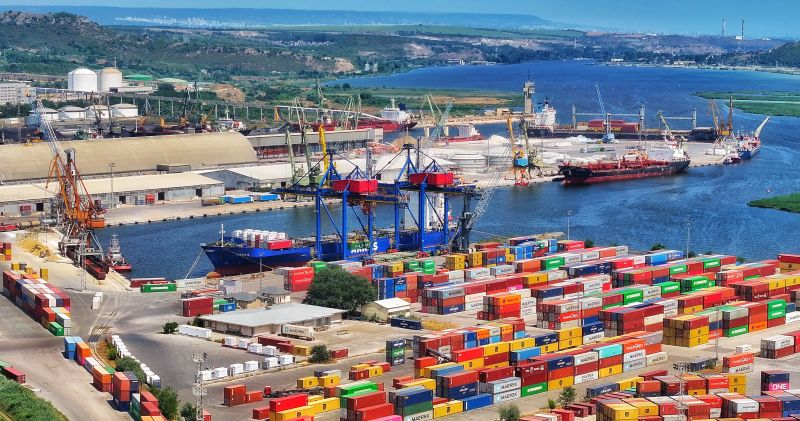
A shipment from Ethiopia—green coffee under five bills of lading across six containers (three 20’ and three 40’ containers) —was en route to the Odesa Seaport. However, due to Russian shelling, the situation became dangerous, and the ports of Greater Odesa were subsequently blocked. Logistics companies and cargo owners redirected their shipments to Constanta en masse, causing a collapse there. Experts from GRANDAR resolved the issue by rerouting the cargo to the Bulgarian seaport of Varna.
The cargo was split into pairs, and tent trucks were sourced. Some trucks operated under the TIR (Transports Internationaux Routiers) procedure, while others were cleared using T1 transit declarations.
Two trucks were loaded simultaneously. Since the weight in the 40’ containers exceeded EU limits while the 20’ containers were under-limit, they were paired up as 20’ + 40’.
The cross-stuffing of the two containers was performed directly at the port to save on warehouse handling fees. Two trucks would enter, two containers were brought in, and the first truck was loaded with the 20’ container plus a portion of the cargo from the 40-foot container. The second truck took the remaining bulk of the cargo from the 40’ container.
The cargo—floor-loaded green coffee in bags without pallets—was accounted for by weight. The bags were divided, and an additional specification was issued. The trucks transported the cargo accompanied by specifications, two T1 transit customs declarations, and two CMR international consignment notes, matching the two invoices and two distinct shipments. Consequently, both vehicles carried cargo within identical legal weight limits.
The trucks traveled in pairs through Bulgaria and Romania to the Kyiv region for customs clearance and final unloading.
Wherever difficulties arise, GRANDAR always finds a solution.