
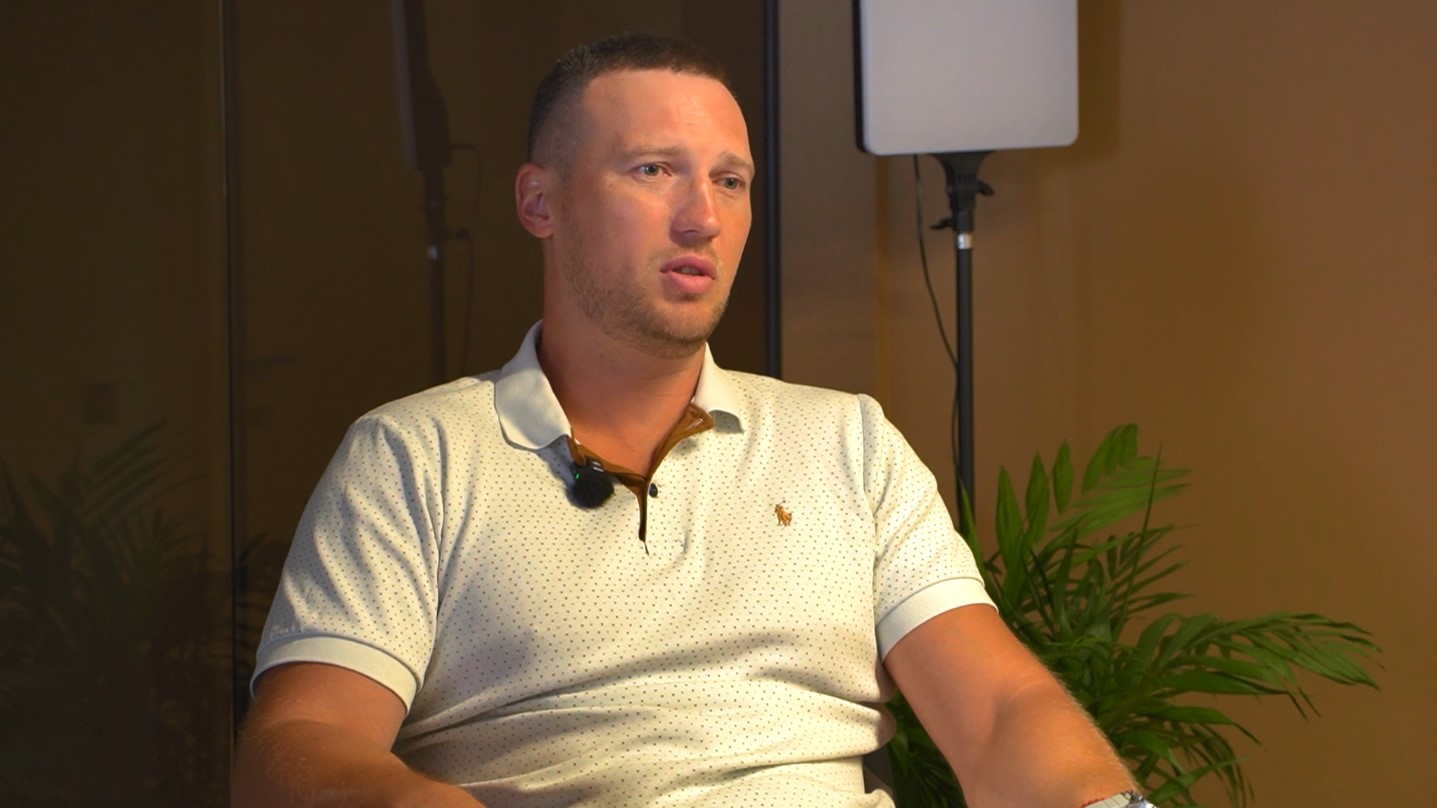
GRANDAR was founded during the full-scale war – in 2025, but has already carved out its niche in the logistics sector. As co-founder and managing director Oleksii Abramov noted, the decision to create the company was deliberate and, to some extent, even dictated by the market situation. The war has radically changed logistics in Ukraine. Old routes have ceased to be stable, creating a need to constantly combine sea, road, rail and river transport, quickly restructure supply routes and make decisions amid high uncertainty. And although GRANDAR is a young company, every specialist has substantial experience in logistics.
«We saw that there was room in the market for a company that would not simply sell transportation services, but would take responsibility for solving the client’s logistics task from start to finish. That is why we decided to create GRANDAR. Competition did not scare us. On the contrary, we believe that a challenging market shows a company’s professional level very well», - Oleksii Abramov emphasized during a meeting with Dmytro Barinov, president of the Ukrainian Ports Association «Ukrport».
GRANDAR operates in international logistics and freight forwarding services. Its main focus is organizing cargo transportation using sea, road, rail and river transport.
«We can organize either an individual transportation operation or a complete logistics chain: cargo transportation, transshipment, port operations, customs clearance, delivery to the final recipient. Our main advantage is not scale, but the flexibility and experience of our team. In large companies, decisions often go through several levels of approval. We can respond much faster to changing circumstances — for example, when today the cargo needs to go through Chornomorsk, tomorrow through Reni, and the day after tomorrow the optimal route is through Constanța», - the managing director of GRANDAR explained.
Regarding the situation in the ports of Greater Odesa, Oleksii Abramov emphasized that it is not yet appropriate to use the phrase «completely blocked» in relation to them, since the authorities have not officially announced the closure of the ports, and, moreover, the Ukrainian Maritime Corridor, albeit at a significantly lower intensity, continues to operate. But the risks are indeed extremely high now, which is why individual vessel calls and services are being suspended.
GRANDAR does not tie a client to a single route.
Instead, the company’s specialists can offer cargo owners several scenarios:
- redirecting sea cargo to Constanța with subsequent delivery by road or rail;
- using the ports of Reni and Izmail;
- combined schemes via the Danube;
- rail routes to Romania and other EU countries;
- transportation by road through the western border;
- combining several modes of transport within a single logistics chain.
«It is especially important now to have several alternatives even before transportation begins. We consider this one of the key principles of modern Ukrainian logistics», - the company’s head noted.
Comparing the readiness of the authorities, regulatory bodies, infrastructure and business for the blockade of the ports of Greater Odesa in 2022 and now, Oleksii Abramov emphasized that the difference is enormous. After all, in 2022 no one had a ready-made operating model for conditions of a complete blockade of seaports. In fact, all market participants — the state, business, carriers, customs, railways, ports — were forced to create a new logistics system practically from scratch.
Today, in Oleksii Abramov’s view, the system is much more adapted. New international routes have emerged, logistics hubs have been established in Romania and other EU countries, businesses have gained experience working via the Danube and the western border, and new customs and transit mechanisms have been created and tested.
The Ukrainian Maritime Corridor also plays an important role. Since its launch in September 2023, hundreds of millions of tonnes of cargo have already passed through the ports of Greater Odesa.
«So today we are no longer returning to March 2022. We have experience, alternative routes and a much better understanding of how to act during large-scale disruptions. But this does not mean that the system has become invulnerable. On the contrary, the main task today is to constantly increase the number of alternatives», - the GRANDAR co-founder added.
The ports of Greater Odesa truly cannot be replaced. If an attempt is made to replace maritime exports through Greater Odesa solely with Danube ports and western border crossings, the system indeed does not have sufficient capacity, Oleksii Abramov believes.
Constraints arise simultaneously at several levels:
- railway capacity;
- availability of rolling stock;
- road transport;
- transshipment capabilities in Danube ports;
- capacity of border crossings;
- capacity of European ports, primarily Constanța;
- hydrological conditions on the Danube;
- logistics costs.
In other words, the problem is comprehensive. And it is telling that Ukraine, the EU, Romania and Moldova are already working together to increase the capacity of the Danube route and the «Solidarity Lanes». For example, the cost of transit of Ukrainian cargo by rail through Moldova has been reduced by 50% until the end of this year.
Oleksii Abramov notes that Western Ukraine and the Danube can significantly increase their volumes, but they are unable to fully replace the deep-water ports of Greater Odesa.
GRANDAR works with all categories of cargo – from containerized and general cargo to agricultural products, metals, equipment and other industrial cargo.
It is difficult to say now that any particular industry has completely “come to a standstill”. Ukrainian businesses have learned to operate amid constant change.
But the agricultural sector remains the most sensitive to the situation, emphasizes the head of GRANDAR:
«For agribusiness, logistics is effectively part of the cost of production. If delivering grain to a port or final buyer becomes too expensive, an export transaction may lose its economic rationale. Therefore, today the issue of logistics for farmers is no longer simply a matter of speed. It is a matter of the profitability of the business itself».
Thus, Ukrainian logistics today is a sector where stability is impossible without a readiness to constantly adapt. Changes in routes, the situation in ports, infrastructure capacity and security risks require logistics companies not only to act promptly, but also to be able to calculate alternative scenarios in advance.
GRANDAR builds its operations precisely on this approach. The company does not limit itself to arranging an individual shipment, but addresses the client’s logistics needs comprehensively – from finding the optimal route and organizing transportation to customs clearance, transshipment, and delivery of the cargo to the final recipient.